Fear-Free Dentistry
A significant number of Americans do not visit the dentist for regular checkups because they are too fearful or suffer from dental anxiety. Sedation dentistry offers an excellent way to provide a safe, anxiety-free, dental experience to those who are afraid of the dentist.
Sedation dentistry is often mistakenly thought to induce sleep. In fact, most sedatives allow the patient to stay awake during the procedure. Sleepiness is a side effect of some medications, but nitrous oxide, oral conscious sedation and IV sedation only work to calm anxiety throughout the dental visit.
Sedation dentistry is popular because most sedatives can be taken by mouth, meaning no injections, no anxiety and no pain. Some sedatives work so effectively that even the smells and details of the procedure cannot be recalled afterwards. Safety and compliance are two important aspects of treatments, so sedation dentistry offers both the individual and the dentist the best alternative.
Whatever the form of sedative, it is essential to be accompanied by a caregiver. Sometimes, sedatives are provided the night before the dental visit, which means that driving to or from the appointment is not advisable.
Book A Sedation Dentistry Consultation
Advantages of Sedation Dentistry:
- Anxiety is alleviated.
- Few side effects.
- More can be accomplished during each visit.
- No needles.
- No pain.
- Perfectly safe.
- Procedures seem to take less time.
What kinds of sedatives are available?
The most popular types of dental sedatives are nitrous oxide, oral conscious sedation, and IV sedation. Different levels of sedation (mild, moderate and deep) can be utilized depending on individual needs. Before administering any sedative, the dentist must analyze the full medical history of the patient, taking note of any current medications.
Here is an overview of some of the most common types of dental sedatives:
Nitrous Oxide
Nitrous oxide, or “laughing gas,” is used as a mild sedative. It is delivered through a nose hood, and is administered throughout the entire procedure. Nitrous oxide elevates the general mood and can evoke a general sense of well-being. Most importantly, it relieves anxiety and reduces pain during the procedure. In addition, some tingling and numbness may be felt. There are few side effects associated with nitrous oxide, and it has been safely used in dentistry for many years.
IV Sedation
Intravenous sedation is a moderate type of sedation. Patients who have previously experienced IV sedation often report feeling like they slept through the entire procedure. Generally, IV sedation is used for shorter treatments. It is administered via direct injection into the bloodstream, which means the effects are immediate. Sometimes patients feel groggy and sleepy when the IV sedatives are withdrawn. This is why it is important to bring a designated driver for the drive home.
Oral Conscious Sedation
Oral conscious sedation is an excellent choice for people who fear needles. Oral medication is provided prior to treatment in order to induce a moderate state of sedation. Though oral sedatives do not cause sleep, they usually dull the senses. This means that most patients cannot remember the pain, smells or noises associated with the procedure. Usually, a dose of medication is taken prior to the appointment, and then topped up during the procedure as required.
Brown Road Dental offers Sedation Dentistry for a relaxed patient experience!
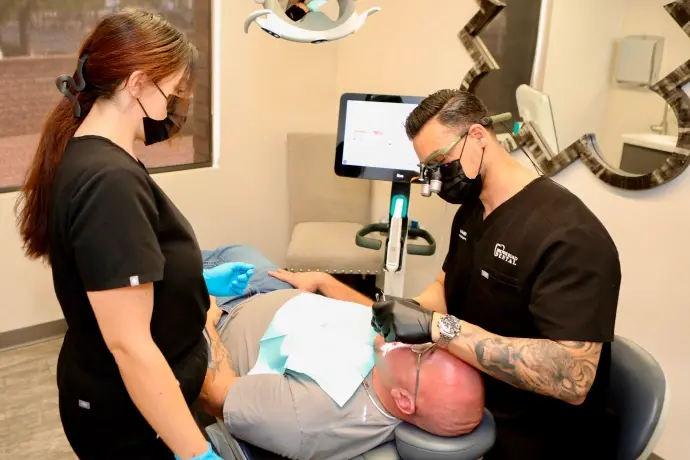
If you are looking for sedation dentistry in Mesa, AZ, the team at Brown Road Dental can accommodate your needs. Whether you have an intense fear of dentistry or struggle with a particularly bad gag reflex, we will work to find the best way to help you relax. Working with a relaxed patient allows us to devote all of our attention and concentration to the procedure at hand, ensuring the best results possible for your needs. In addition, knowing that you can be comfortable in the dentist’s chair can make a huge difference to feelings of anxiety you might experience in the days before your appointment.
Our Sedation Options
We offer various sedation methods for anxious or fearful patients. IV sedation is particularly useful for patients with an intense phobia of the dentist. This method changes your perception of the length of the procedure by inducing either partial or full memory loss for the duration of the medication’s influence on your body – an hour-long appointment suddenly becomes a breeze. We also offer nitrous or oral-conscious options to reduce nervousness and help you relax. While we see patients over the age of one, we do not offer pediatric IV Sedation. However, the nitrous or oral conscious option may still be an option for children.
We always conduct a thorough assessment to determine any patient’s suitability for our different sedation methods. If you opt for something other than nitrous, our safety procedure stipulates that you must have someone available to take you home. We also ask you to refrain from eating for the six hours prior to the appointment and to stick to clear liquids for the two hours prior to arriving at the office. Please call us for further instructions if you are appointed for IV Sedation and have questions.
Our Approach
Our caring approach makes us one of the very best providers of sedation dentistry in Hesperia. We can heat up shots to make injections less painful, and we have a tool that matches the pH of the anesthetic to your body’s pH (providing a faster-acting effect). We offer computerized injections that allow us to use a small gauge needle and reduce discomfort by controlling the speed and rate of injections. The accuracy provided by computerized injections also means we can numb just one tooth instead of your entire mouth.
We also believe that sedation can be a powerful tool to help patients transition to a more normal visit. We have seen many people overcome their fear of dentistry through sedation, and we would love to help you work towards that goal. Patients can begin to feel more comfortable with their dental visits if know they will be made less anxious through sedation, and in time the need for sedation may diminish in response.
Uncompromising Safety
Infection control in our office is also very important to us. To protect our patients and ourselves, we strictly maintain sterilization and cross-contamination processes using standards recommended by the American Dental Association (ADA), the Occupational Safety and Health Administration (OSHA), and the Center for Disease Control (CDC).